
Process Safety Beacon: Decontaminate Before Opening!
In June 2024, a contractor employee was exposed to a small quantity of hydrogen fluoride (HF), a toxic and highly corrosive fluid. The contractor was hospitalized but recovered.
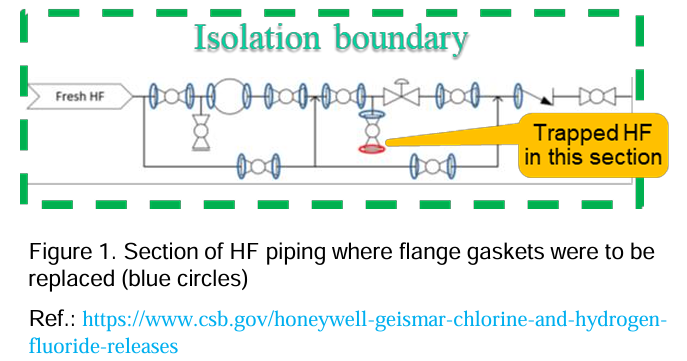
The site was in the process of replacing flange gaskets in HF service. The section shown in Figure 1 was where the incident occurred. A decontamination plan was developed with several drawings of the piping. In preparation, operations isolated upstream and downstream of this section, then connected it to a vacuum source. The vacuum system and nitrogen purge was used to decontaminate the piping inside the isolation boundary. However, one small section (red circled) was not decontaminated since the operator did not have all the drawings for the piping.
On the day of the incident, the contractors requested the permit to work. The operator checked the isolation. The contractor began opening the flanges while wearing Level B acid protection PPE with supplied air. The equipment was opened and there was no pressure or other evidence of HF. The operator said it was “proven” to be empty and decontaminated. Operations then allowed the contractors to complete the work wearing Level D, general duty, PPE.
As the maintenance contractors continued their work, they removed the flange bolts from the (red) blind-flange below the drain valve. Suddenly, a small amount of HF, less than 1 pound (<450g), escaped from the joint and contacted the contractor’s face. He was treated with calcium gluconate and transported to hospital. He was hospitalized for 2 days to treat second degree acid burns.
Did you know?
- The goals of Safe Work procedures include:
– Operations understands what maintenance or contractors are assigned to do. Those performing the work need to know the scope of work.
– Operations establishes isolation boundaries so that no hazardous fluids or energy can reach the area where the work will be done.
– The system inside the isolation boundaries are safe – de-pressurized and decontaminated. - Draining, purging and emptying piping can be difficult and may take several steps to ensure the piping section is free of hazards; especially where there are piping dead legs.
- After the piping is clear, it can be isolated, following the lock and tag procedure.
- Selection of PPE must be done by a qualified person. Guidance on PPE levels is available at: https://oshacode.com/hazwoper-ppe-levels/
What can you do?
- All isolations need a field walk down to confirm the plan has been followed and the drawings are correct.
- Assume that all isolation block valves may leak and wear full PPE until the piping is proven clear of hazards. In this incident, the failure to clear one small section led to a serious injury. Under different conditions, it could have been fatal.
- Know the hazards of the materials and wear the correct PPE.
- Follow the procedures for isolation and opening of equipment including proper PPE.
- If a valve is leaking through or there’s some other problem as you isolate or decontaminate, discuss the situation with your supervisor before proceeding.
Failure to properly isolate & decontaminate lines have led to many injuries & fatalities
Download the latest Process Safety Beacon
Source: ©AIChE 2026. All rights reserved.