

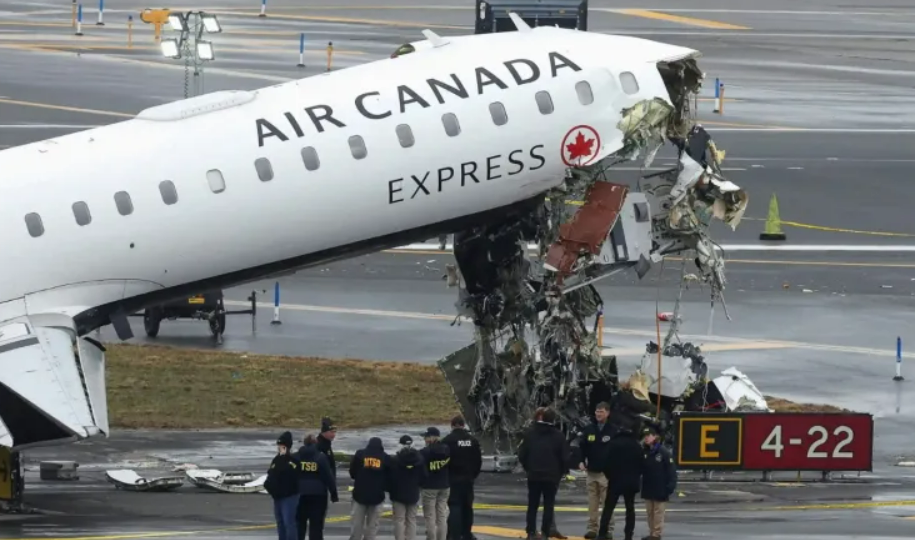
USA – NTSB Issues Preliminary Report on Deadly LaGuardia Runway Collision
The National Transportation Safety Board (NTSB) has released its preliminary report into the fatal runway collision that occurred at New York’s LaGuardia Airport (LGA) on March 22, 2026. The accident involved an Air Canada Express regional jet and an airport firefighting vehicle, resulting in the deaths of both pilots and injuries to 41 others. According to the report, the collision took place at approximately 11:37 p.m. local time, marking the airport’s first fatal aviation accident in 34 years.
The aircraft involved was a Bombardier CRJ-900LR, registration C-GNJZ, operated by Jazz Aviation on behalf of Air Canada Express as Flight 8646 from Montreal–Trudeau International Airport. The aircraft was carrying 72 passengers and four crew members when it collided with an Oshkosh Striker 1500 airport firefighting truck operated by the Port Authority of New York and New Jersey.
While the NTSB has not yet assigned probable cause, its preliminary findings identify multiple contributing issues, including conflicting air traffic control clearances, surface detection system failures, and the absence of a transponder on the emergency vehicle.
Sequence of Events
Emergency Convoy Deployment
Before the collision, the firefighting vehicle was leading a convoy of six emergency response units. The convoy had been dispatched to assist with a separate incident involving a United Airlines Boeing 737 MAX 8 that had reported a cabin odor after two aborted takeoffs. At the same time, the Air Canada Express CRJ-900 was cleared to land on Runway 4.
Conflicting ATC Instructions
Investigators found that air traffic control simultaneously cleared the fire truck to cross Runway 4 at the Taxiway Delta intersection.
According to the NTSB timeline, this clearance was issued just 12 to 20 seconds before the aircraft touched down. A critical issue identified in the report is that the aircraft crew and the emergency convoy were operating on separate radio frequencies. As a result, neither party was aware of the conflicting clearance issued to the other.
Final Seconds Before Impact
Once the controller recognized the conflict, an urgent radio transmission was made instructing the vehicle to stop: “stop, stop, stop, Truck 1 stop” The truck’s turret operator reportedly heard the initial transmission but did not immediately realize the instruction was directed at their vehicle.
By the time the warning was understood and the aircraft’s lights became visible, the truck had already entered the runway. The CRJ-900, approaching at approximately 114 knots (131 mph), struck the side of the firefighting vehicle.
Casualties and Damage
The impact caused catastrophic damage to the forward section of the aircraft, destroying the cockpit and front galley.
The NTSB confirmed the deaths of both pilots:
- Captain Antoine Forest, 24
- First Officer Mackenzie Gunther, 30
A total of 41 people were injured, including:
- 39 passengers and crew members
- 2 occupants of the firefighting truck
One flight attendant seated in the forward jump seat was ejected onto the tarmac and survived with severe injuries, including shattered legs and a fractured spine. Because emergency crews were already responding to the unrelated incident nearby, rescue personnel were immediately present, which officials believe prevented additional fatalities.
Technical Findings
ASDE-X System Failure
A major focus of the preliminary report is the failure of LaGuardia’s Airport Surface Detection Equipment, Model X (ASDE-X).
This system is designed to track aircraft and ground vehicle movements and provide collision warnings to controllers. However, no alert was generated before the crash. The investigation determined that the fire truck was not equipped with a transponder, making it effectively invisible to the automated detection system. Without transponder data, ASDE-X was unable to identify the runway conflict in time.
Runway Lighting
The NTSB also reviewed the runway entrance lights, which serve as stop signals for vehicles approaching active runways. The lights reportedly remained illuminated until about three seconds before the collision. Because the system is designed to extinguish the lights only moments before an arriving aircraft reaches the intersection, investigators noted that the warning margin was insufficient to prevent the accident.
Environmental and Staffing Factors
Weather conditions at the time included:
- winds from 050 degrees at 7 knots
- broken cloud ceiling at 9,000 feet
- approximately 4 miles of visibility
- mist and light rain
These nighttime low-visibility conditions likely reduced the flight crew’s ability to visually identify the dark-colored vehicle. The report also noted that LaGuardia’s control tower was staffed with 33 controllers that night, below its target staffing level of 37.
Preliminary Analysis
The findings strongly suggest a layered systems failure consistent with the “Swiss cheese model” of accident causation, in which multiple safeguards fail simultaneously.
Key breakdowns included:
- conflicting ATC clearances
- communication separation by radio frequency
- lack of transponder equipment
- failure of automated warning systems
- reduced visibility
- below-target ATC staffing
The absence of a transponder on an active emergency vehicle operating in the airport movement area is expected to become a major focus of future FAA safety actions. Industry observers anticipate that airport authorities may move quickly to require transponders on all Aircraft Rescue and Firefighting (ARFF) vehicles before the NTSB’s final report is issued.
Source: NTSB. All rights reserved.