

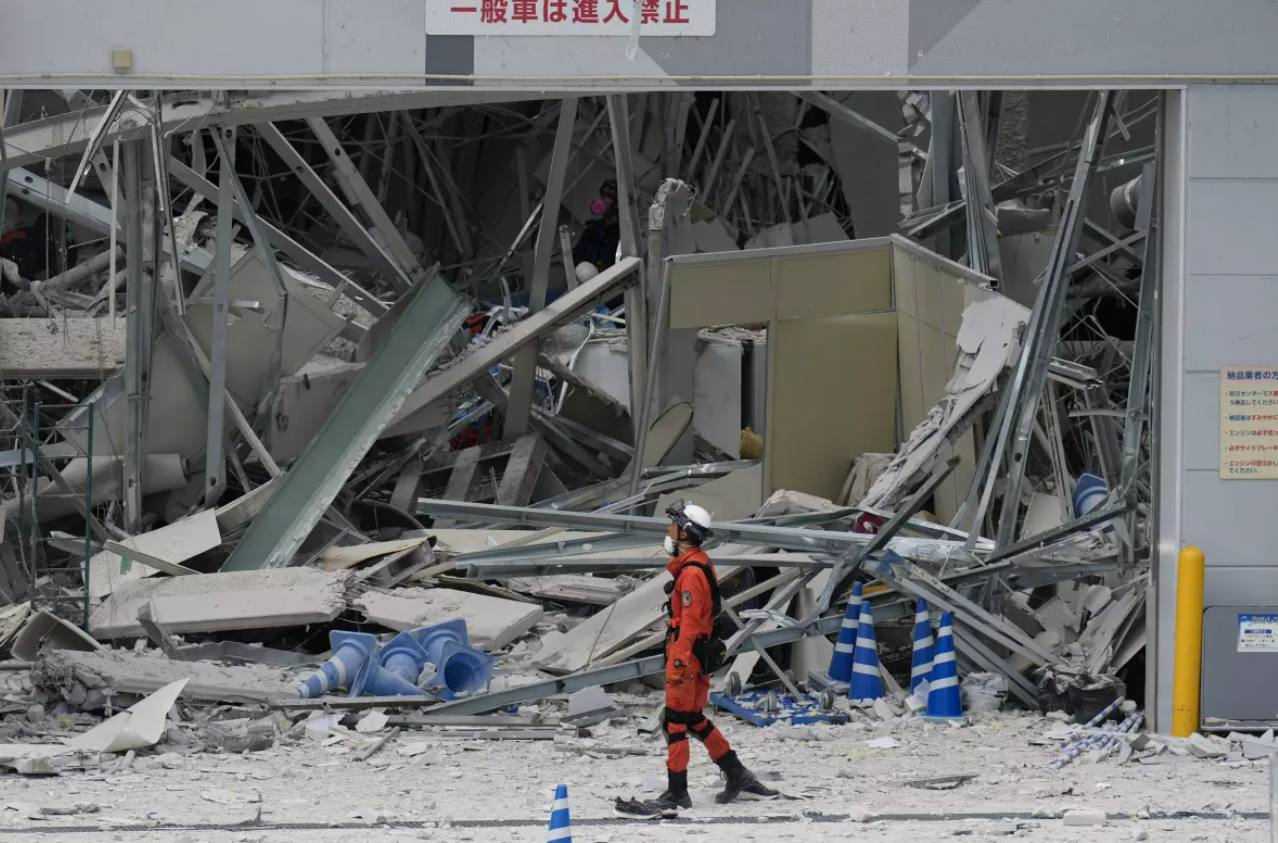
JAPAN – Rescuers Race to Find Survivors After Powerful Kumamoto Earthquake
Rescue teams continued searching for survivors on Wednesday after a magnitude 7.1 earthquake struck Kumamoto Prefecture, leaving at least 13 people dead and five others missing. The quake, which reached the maximum shindo 7 intensity on Japan’s seismic scale, caused widespread destruction, disrupted essential services, and triggered a deadly explosion at a major shopping mall.
Authorities warned that the number of casualties could increase as police, firefighters, and members of the Self-Defense Forces searched damaged buildings across the prefecture. Hundreds of people were injured, while nearly 9,000 residents sought shelter following the disaster. Officials also cautioned that strong aftershocks may continue for several days.
One of the most serious incidents occurred at Aeon Mall Kumamoto in the town of Kashima. Approximately 3,000 shoppers were inside the complex when the earthquake struck. Staff safely evacuated customers before a powerful explosion occurred about 50 minutes later, destroying part of the building. Three employees were confirmed dead, while three others remain missing. Investigators believe a gas leak may have caused the blast, although the exact cause is still under investigation.
Another major tragedy unfolded at Nippon Paper Industries’ mill in Yatsushiro, where the earthquake caused a smokestack to collapse. Five workers were confirmed dead, and four others remain unaccounted for as search efforts continue.
The earthquake severely disrupted infrastructure across Kyushu. More than 31,000 households lost electricity, while around 84,000 homes in Kumamoto and Nagasaki prefectures were left without running water. Several expressways were closed, and damage to approximately 200 locations along the Kyushu Shinkansen forced rail service suspensions. Limited train operations are expected to resume between Hakata and Kumamoto, although services farther south remain suspended.
Government officials announced emergency measures to support affected communities, including the delivery of food, drinking water, portable air conditioners, and mobile generator trucks. The assistance comes as the region faces temperatures exceeding 34°C, raising concerns about heat-related risks in evacuation centres.
Residents described terrifying scenes during the earthquake. Andrew Mitchell, an assistant professor at Kumamoto University, recalled hearing what he described as “the sound of the earth tearing itself apart” as furniture shifted and dishes shattered inside his apartment. He urged people across Japan to prepare emergency supplies, warning that simple precautions can save lives. Social media users also shared photographs and videos showing damaged buildings, scattered merchandise, and widespread destruction.
The Japan Meteorological Agency warned that additional powerful earthquakes remain possible during the coming week, particularly over the next several days. Officials explained that the earthquake resulted from shallow horizontal fault movement and said it is too early to determine whether it is directly connected to the devastating Kumamoto earthquakes of 2016, whose epicentre occurred near the same fault system.
Photo credit: Hiro Komae. All rights reserved.