

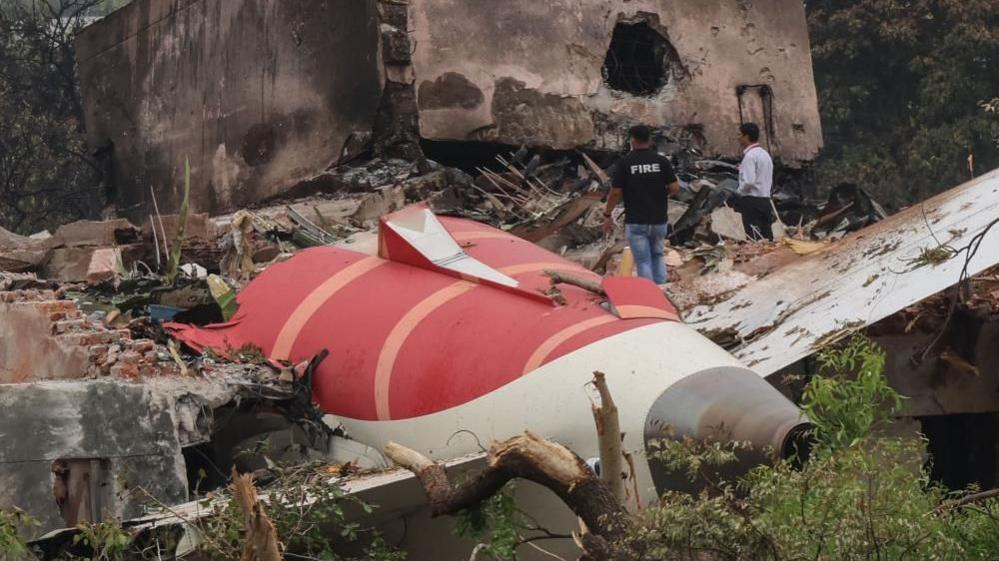
INDIA – Campaigners allege past safety issues on Air India jet that later crashed
Investigators in India are continuing to examine the causes of last year’s Air India crash in Ahmedabad, while aviation safety campaigners in the United States have raised fresh concerns about the aircraft’s technical history.
The Boeing 787 Dreamliner crashed on 12 June shortly after taking off for London, killing 260 people. India’s Aircraft Accident Investigation Bureau (AAIB) is leading the inquiry, with support from American officials because the aircraft and its engines were designed and built in the US.
As is standard practice, the AAIB issued a preliminary report one month after the crash. Although intended to outline established facts rather than draw conclusions, a short section of the document triggered intense debate.
The report stated that moments after take-off, the aircraft’s fuel control switches were moved from the “run” position to “cut-off,” cutting fuel supply to the engines and causing a rapid loss of thrust. While the switches were later returned to their normal setting, the engines did not recover in time.
It also said that a cockpit voice recording captured one pilot asking the other why the switches had been cut off, with the response denying responsibility. No full transcript was released.
That passage led some commentators in India and the US to suggest pilot action—either accidental or deliberate—was responsible for the crash. However, this interpretation has been strongly challenged by victims’ lawyers, pilot associations, safety advocates, and some technical experts, who argue the focus on the flight crew may be premature and misleading.
Many believe attention has been diverted away from the possibility of a technical malfunction.
Against this backdrop, the US-based Foundation for Aviation Safety (FAS) says it has uncovered evidence suggesting the aircraft involved had a long record of serious technical problems before the accident. The organisation says it has shared its findings with the US Senate.
According to the Foundation, the jet—registered VT-ANB—experienced repeated system failures dating back to its earliest days in service with Air India. The aircraft was one of the first Dreamliners built, entering service in early 2014 after its first flight the previous year.
FAS claims documents show a pattern of faults linked to engineering, manufacturing, maintenance, and quality-control issues. These reportedly included electronics and software failures, repeatedly tripping circuit breakers, damaged wiring, short circuits, power losses, and overheating electrical components.
One of the most serious incidents cited by the group allegedly occurred in January 2022, when a fire broke out in a P100 power distribution panel during a flight into Frankfurt. Pilots received fault warnings during descent, and inspections later revealed damage severe enough to require full replacement of the panel.
The P100 panels distribute high-voltage electrical power generated by the engines throughout the aircraft. The Dreamliner relies far more heavily on electrical systems than previous passenger jets, having replaced many mechanical and pneumatic systems with lighter electrical alternatives to improve efficiency.
That design philosophy caused difficulties early in the 787’s operational life. In 2013, a lithium-ion battery fire on a Japan Airlines aircraft led regulators to ground the global Dreamliner fleet temporarily. The P100 panel itself had already been redesigned in 2010 following a fire on a test aircraft.
The Foundation says its concerns extend beyond the aircraft involved in the Ahmedabad crash. It claims to have reviewed around 2,000 reports of failures across hundreds of 787s operating in the US, Canada, and Australia. These include water leaks into wiring bays, an issue previously acknowledged by the US Federal Aviation Administration.
The organisation is led by Ed Pierson, a former senior manager at Boeing’s Renton factory, who has been a long-standing critic of the company’s safety and quality-control practices. He has described the preliminary report into the Air India crash as “woefully inadequate.”
Boeing has consistently maintained that the 787 is a safe aircraft with a strong operational record, noting that prior to the Ahmedabad accident, the model had flown for nearly 15 years without a fatal crash.
Photo credit: BBC News. All rights reserved.