SPAIN – Spain train collision near Urda kills at least 68 as investigators examine signalling failure
At least 68 people have been killed and 107 others have required hospital treatment after two high-speed trains collided near Urda, in Spain’s Toledo province, on Wednesday morning. Investigators are examining a possible error in railway traffic management after a signalling system malfunction reportedly left several trains stopped along the line.
The collision involved a Renfe service and a train operated by private rail company Iryo, both travelling south from Madrid towards Andalusia. According to Transport Minister Óscar Puente, the Iryo train had stopped on the tracks when the Renfe service was instructed to resume its journey, subsequently striking the rear of the stationary train.
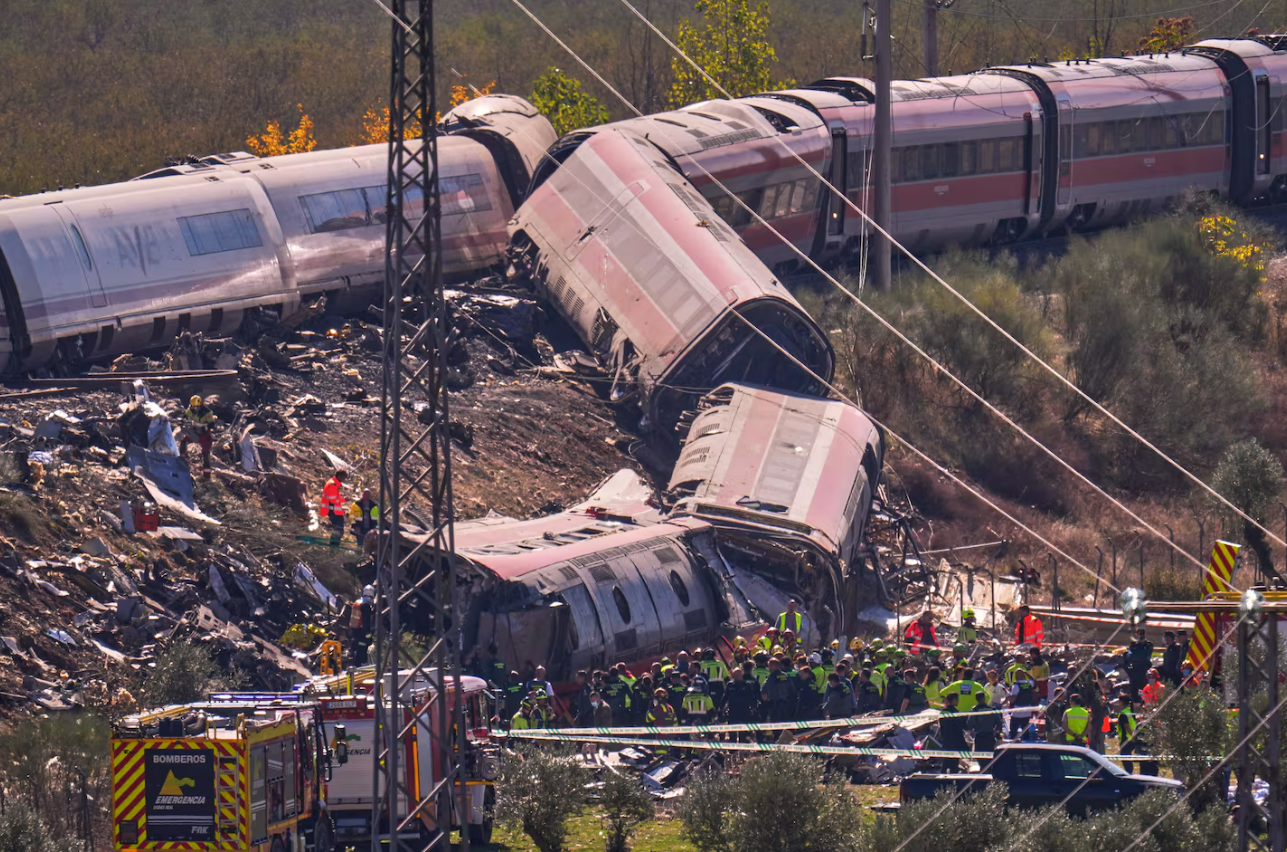
The impact derailed several carriages, leaving wreckage scattered across an embankment and at least one carriage on an elevated section of track. Emergency crews worked through the damaged vehicles as the search for victims continued.
Regional authorities in Castilla-La Mancha confirmed that the death toll had reached 68 by Wednesday afternoon. Officials warned that further casualties remained possible because rescuers had not yet been able to access the lowest sections of the damaged carriages. Of those taken to hospital, 15 were reported to be in a serious condition.
The two trains were carrying a total of 544 people, according to officials.
Signalling malfunction preceded the collision
Initial information released by Puente indicates that the incident may have followed a computer malfunction affecting the LZB signalling system at approximately 8.30am local time.
The system is designed to help prevent collisions by stopping trains when the line ahead is occupied. Following the reported malfunction, an estimated six trains were brought to a halt along approximately 63km of track.
Rail traffic was subsequently managed by the central control centre in Madrid, which operates around the clock. Puente said that, minutes after the technical problem occurred, control room operators instructed at least two trains to resume normal operations despite a stop signal remaining in place.
The Iryo train was stationary when the Renfe service received its instruction to continue. The Renfe train then travelled approximately 25km before colliding with the Iryo service around 17 minutes later.
The speed of the Renfe train at the time of impact has not been established. The section of railway involved permits speeds of up to 200km/h.
Puente said the control centre had sufficient time to identify the error but failed to correct it before the collision. He described the decision to authorise the trains to continue under those circumstances as inexplicable, while emphasising that responsibility had not yet been formally established.
The minister also reported that another train had received a similar instruction that morning. In that case, the driver questioned the order and requested permission to proceed under a restricted line-of-sight procedure. This requires a train to move at a significantly reduced speed, allowing the driver to check that the track ahead is clear.
According to Puente, the control centre accepted that request.
Investigators are now examining the sequence of communications, the technical failure and the decisions made by railway personnel to establish how the collision occurred.
Rescue teams search wreckage as casualties are identified
The collision prompted a large-scale emergency response involving local, regional and national services. Rescue workers continued searching the derailed carriages on Wednesday as authorities attempted to reach areas that remained inaccessible.
Photographs from the scene showed twisted metal, broken panels and debris scattered down the embankment beneath the railway. At least one carriage remained on an elevated section of track.
Urda, a municipality surrounded by olive groves and vineyards, became the centre of the rescue operation. A local sports centre was converted into a triage facility for people with minor injuries, while a nearby hall was made available to relatives searching for missing loved ones.
Emergency vehicles moved continuously through the town as residents brought food and bottled water to those waiting for information.
Passengers also described the violence of the impact. Miguel, who was travelling with several colleagues in the rear carriage of one of the trains, told Cope radio that they heard an enormous roar followed by a prolonged impact lasting around 10 seconds.
He said the noise made him fear that the train was about to derail. Looking through a window, he saw a badly damaged train that he believed was the other service involved in the collision.
Among the first victims identified publicly was José Manuel Chacón, a 31-year-old member of Spain’s Guardia Civil. The national law enforcement agency expressed its condolences to his family, friends and colleagues.
Spanish media also reported that several people remained missing, including a former minister associated with the People’s Party and foreign nationals believed to have been visiting the country.
Investigation and safety concerns
Puente said rear-end collisions of this kind were highly unlikely and indicated that the circumstances surrounding the reported control centre error required close examination.
The investigation will need to establish how the signalling system failed, why trains were reportedly authorised to resume normal operations while stop signals remained in place, and whether the applicable safety procedures were followed.
Prime Minister Pedro Sánchez announced three days of mourning for the victims, describing the disaster as a tragedy for the country. He said any failures in safety systems or negligence identified by investigators would be addressed with the utmost severity.
The collision is Spain’s second major fatal high-speed rail accident this year. In January, 46 people died when trains operated by Renfe and Iryo collided near Adamuz in Andalusia. However, Sánchez cautioned against assuming that the two accidents shared the same cause, stressing that conclusions must be based on the respective investigations.
As rescue operations continue, authorities are working to account for everyone on board and determine the precise circumstances that led to Wednesday’s collision.
Photo credit: Manu Fernandez. All rights reserved.