

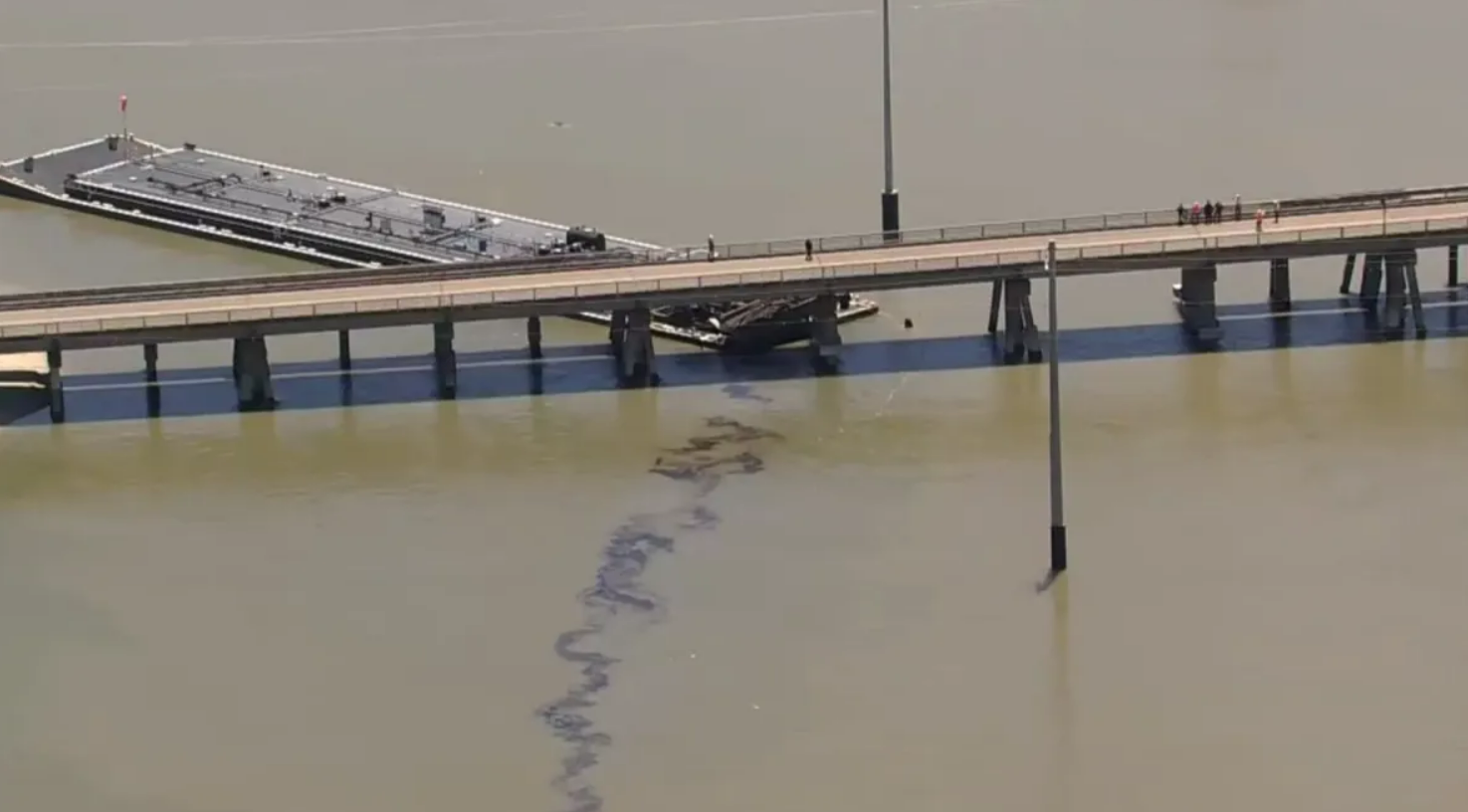
USA – NTSB: Unexpected tidal current contributed to Galveston barge collision
The National Transportation Safety Board (NTSB) has concluded that stronger-than-forecast tidal currents played a key role in a barge collision in the Galveston Channel on 15 May 2024, prompting tighter safety measures at the Texas International Terminal.
According to the agency’s marine investigation report, tidal currents during the incident reached speeds of up to 1.8 miles per hour (2.9 kilometres per hour), nearly double the expected peak level. Investigators determined that the captain of the towing vessel was unable to maintain control of the tow after it left the protection of the terminal breakwater and encountered the stronger flood current.
The towing vessel LCPL Phillip C George, operated by Martin Operating Partnership, departed the Texas International Terminal at around 09:41 while moving two loaded tank barges through the Galveston Channel. Shortly after departure, the current forced the vessel’s port quarter into a terminal dolphin, causing significant strain on the tow configuration.
The impact broke the port coupling and centre line connecting the barges, leaving the lead barge, MMLP 321, attached only by a single starboard wire. As the vessel drifted broadside toward the Pelican Island Bridge, the barge’s aft port corner struck a power transmission pole at approximately 09:46, sending sparking electrical cables onto the deck and into the surrounding water.
Moments later, the final coupling wire failed, allowing the barge to drift free. It subsequently collided with a supporting pier shared by the Pelican Island Bridge and an abandoned railway bridge. Falling concrete debris punctured the barge’s cargo tank, leading to the release of approximately 20,000 gallons (75,708 litres) of vacuum gas oil, which spread westward from the bridge area.
The accident resulted in an estimated $8.4 million in combined damages and environmental cleanup costs. A rescue boat operated by Texas A&M University at Galveston recovered an uninjured deckhand from the grounded barge at around 09:51, while the vessel’s captain contacted emergency services.
Following the collision, and two other similar flood-tide incidents within an 18-month period, the US Coast Guard introduced stricter departure requirements at the Texas International Terminal. The updated rules prohibit vessel movements when flood currents exceed 0.6 miles per hour (0.97 kilometres per hour), require the use of an assist boat, and ban strung-out tow arrangements.
Photo credit: NBC 5. All rights reserved.