

Process Safety Beacon: How can we isolate that pump?
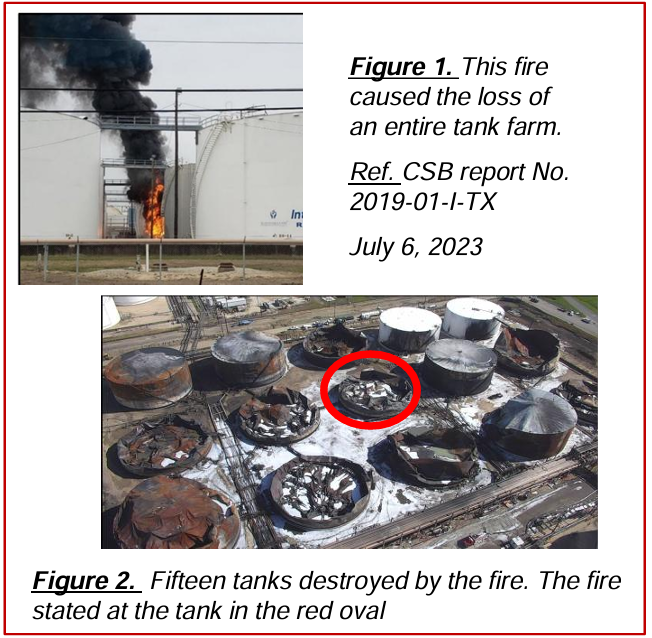
On March 17, 2019, a large fire erupted at a bulk liquid storage terminal in Deer Park, Texas. The fire started near a 3.4 million-gallon (12,870 m3) aboveground, atmospheric storage tank containing a flammable blend of naphtha and butane. The circulation pump seal failed, released the flammable mixture, and friction from the seal failure probably ignited it. Once the fire erupted, operators electrically stopped the pump but were unable to isolate the release. As a result, the fire grew and spread to all 15 tanks located in the same containment area. The fire burned for three days and destroyed all fifteen tanks and their contents.
In this incident, the large volume of flammable product could only be isolated manually. Once the fire began, operators could not safely isolate the pump to stop the release. None of the storage tanks located in this tank farm were equipped with Remotely Operated Emergency Isolation Valves (ROEIVs). These valves are designed to mitigate process releases by remotely isolating the leak more quickly which would prevent or limit the release.
Did you know?
- Pumps have leak points where releases can occur such as the shaft seal, flanges, and the casing seam.
- Seal failures, like in this incident, are often caused by vibration from a bearing failure, impeller imbalance, a loose connection, or improper installation.
- When a release occurs, operators need safe access to the isolation devices. Remote isolation of pumps and other process equipment enables safe isolation.
- Remotely Operated Emergency Isolation Valves (ROEIVs) are sometimes called Emergency Block Valves (EBVs). They can be remotely operable, automatically, by a sensor, or manually from a control panel in the field or control room. Spring-closed valves with a fusible link are another option for isolation.
- Remote isolation systems are safety critical and require regular inspection, testing and training for the employees who operate them.
- Remote isolation systems should be clearly identified in the field and on P&ID drawings, and operators should know their location and how to operate them.
What can you do?
- During Process Hazard Analyses, review how each piece of process equipment could be isolated if a release occurred, especially a fire.
- AIChE has guidance on remote isolation practices at: https://www.aiche.org/ccps/remote-isolation-andshut
- Follow the proper inspection and testing procedures for isolation systems
- When making rounds in the field, check that you can easily access the manual activation systems for isolation and that they are clearly labeled.
Isolating process equipment can reduce the impacts when a release occurs!
Download the latest Process Safety Beacon
Source: ©AIChE 2026. All rights reserved.