

Process Safety Beacon: Uncontrolled heating causes a cylinder explosion.
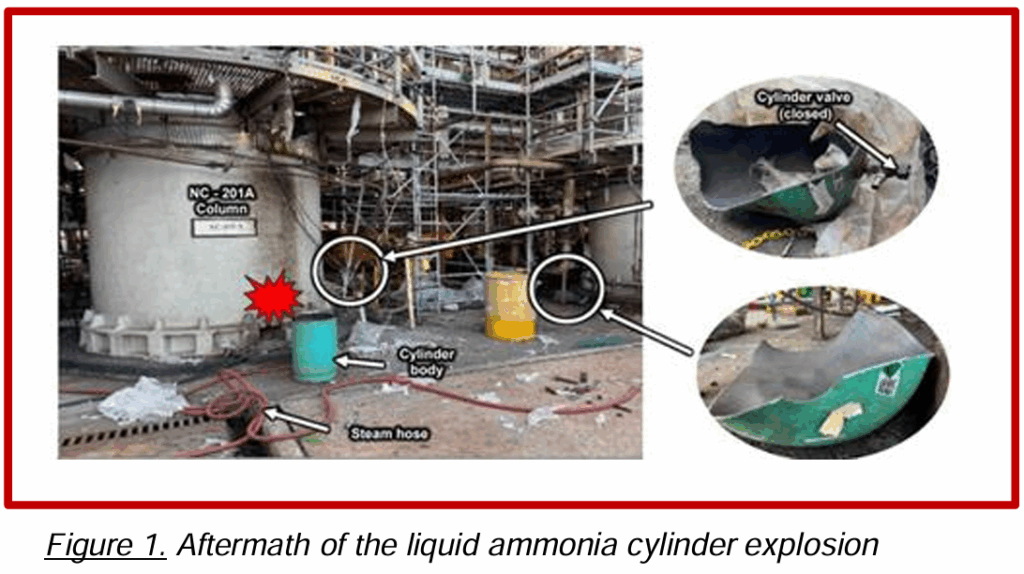
On October 8, 2024, a 150 lb(68 kg) anhydrous ammonia cylinder exploded, seriously injuring four workers at a facility in Baton Rouge, Louisiana. The company was preparing to introduce anhydrous ammonia from the cylinder as a chemical treatment system for turnaround maintenance work. The operations team wrapped the lower half of the cylinder with a rubber steam hose to warm the cylinder and increase the flow of ammonia to the equipment. The steam supply was approximately 300oF (149oC) and 70 psi (4.8 Bar). While the valve on the cylinder remained closed, one of the operators opened the steam supply then continued other preparations for the task. The cylinder exploded, seriously injuring three operators and an operations supervisor. The four injured employees were transported to a hospital, where they were admitted for treatment.
The procedure for the chemical treatment did not address critical safety precautions such as not heating the cylinder with the outlet valve closed. In addition, the cylinder was not protected by a pressure relief device. Heating the cylinder increased the pressure of the liquid ammonia inside the cylinder above the cylinder’s maximum pressure resulting in a boiling liquid expanding vapor explosion (BLEVE).
The probable cause of the incident was the uncontrolled external heating of the liquid ammonia cylinder while it was closed.
Did you know?
- Cylinders are designed for safe transportation of their contents at typical shipping and storage temperatures.
- Materials are shipped in cylinders because they have a vapor pressure that would exceed the pressure rating of other containers.
- Cylinders have their pressure ratings stamped on them.
- Not all cylinders are equipped with a relief device.
- Cylinders that are isolated or without pressure relief must be kept below the safe temperature limit.
- Hoses connecting cylinders to a process can rupture if they are isolated without a relief device, even if there is only heating from the surroundings.
What can you do?
- When using cylinders to feed materials into a process, only use equipment that is rated for the material and the pressure.
- Never assume a cylinder has its own pressure relief device. Use the Job Safety Analysis (JSA) process to determine if an external relief device is needed. ▪ Only apply heat to a cylinder when it is safely connected to the process and the heating process has been reviewed for safe operation.
- Non-standard operations such as this should have a written procedure and/or use the MOC process to ensure safe operation.
Ref: Incident Reports Events Reported to the CSB Under the Accidental Release Reporting Rule (Volume 4, February 18, 2026)
Safely applying heat to cylinders requires a hazard review and a procedure.
Download the latest Process Safety Beacon
Source: ©AIChE 2026. All rights reserved.