

Process Safety Beacon: An Untrained Operator Caused a Release
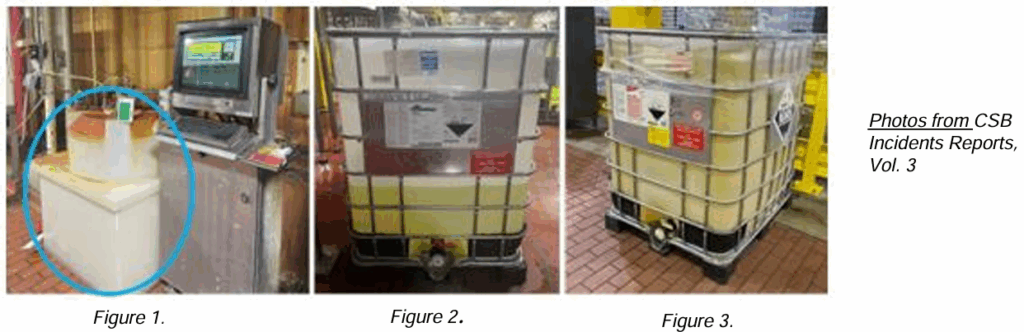
On February 1, 2022, a chlorine gas mixture was released at a facility in Memphis, Tennessee. Three workers required treatment for exposure to the toxic vapor. On the day of the incident, an operator was assigned to refill a tank containing a mixture of sodium hypochlorite, sodium hydroxide, and sodium chloride (“bleach solution”). A mixture of nitric acid and phosphoric acid (“acid solution”) and the bleach solution were stored in separate 330-gallon (1249 L) totes (Figures 2 & 3) in the same area. The trade names of the materials on the totes differed only by one letter (‘Dibac’ versus ‘Dilac’). The operator inadvertently transferred acid instead of bleachsolution into the bleach solution tank, (blue circle, Figure 1) causing a chemical reaction that released the vapor cloud containing chlorine gas. Emergency responders transported 10 employees to the hospital.
The investigation determined that the operator who performed the chemical transfer was not trained on the difference between the bleach and acid materials or on how to perform this task. Also, the written procedure did not include a step for verifying that the correct chemical was selected before connecting the tote to the chemical transfer equipment and that resulted in mixing two incompatible materials.
Did you know?
- Employees handling hazardous chemicals must be trained on the hazards of those chemicals and how to safely perform their jobs.
- Many companies have required training and skill development programs that define required training by job title or function.
- Initial training provides the skill to properly do the job, but retraining on a regular basis ensures the employees stay competent.
- Employees should not be assigned job duties that they are not qualified to perform.
- Competency applies to all employees. Technical staff and leadership personnel also need to be competent.
What can you do?
- Actively participate in all training sessions. What you learn today may save your life tomorrow.
- If asked to perform a task for which you are not qualified, remind your supervisor that you need to be trained first.
- When a coworker asks a question about how to safely do a task, take the time to explain it well and to explain why certain steps are critical.
Training and attention to detail are essential to safe operations !
Download the latest Process Safety Beacon
Source: ©AIChE 2026. All rights reserved.