
Process Safety Beacon: Refinery Cooling Tower Explosion and Fire
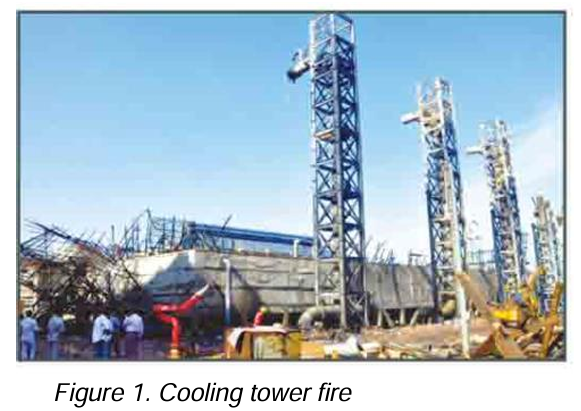
In August 2013, a refinery in India was commissioning a new cooling tower cell. As process water was introduced into the new cell for the first time, a large quantity of light hydrocarbon liquid and vapor was released. It ignited, likely by hot work in the area. In all, 29 people were fatally injured and many more sustained burn injuries.
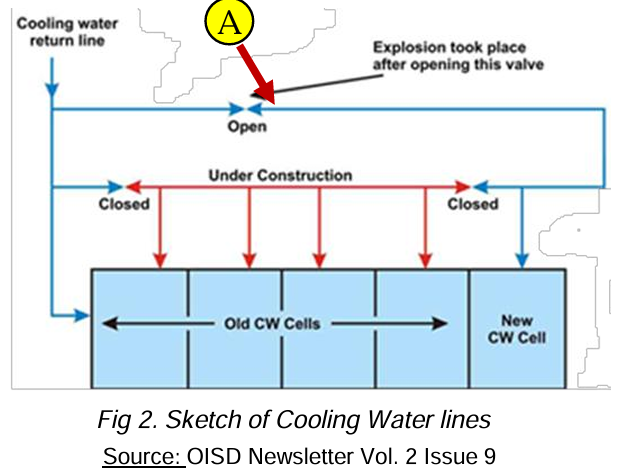
The investigators concluded that flammable hydrocarbons from a leaking heat exchanger had collected in a high point in the cooling water piping. This piping section had no flow until Valve ‘A’ (Figure 2) was opened to commission the new cooling tower cell. Flammable fluid from the leaking exchanger was released into the cooling tower. A large cloud formed in and around the cooling tower and ignited. Many of the injured were contractors working in the area at the time. The company’s practice of stopping work when commissioning new equipment was not followed.
Did you know?
- Most hydrocarbons are lighter than water and can accumulate in high points.
- Tubes in shell-and-tube heat exchangers have much thinner walls than piping. A small amount of corrosion can weaken them and cause leaks.
- Heat exchanger tubes are difficult to inspect since they are inside the shell.
- Start-up or recommissioning can create hazardous situations since some safety systems may be absent or disabled and there may be additional people working in the area.
- Cooling towers are sometimes built with wood or fiberglass internal structures. In a fire, these materials can be difficult to extinguish.
- Cooling towers are often seen as a low hazard process since they “only” process water.
- Cooling tower design may include safety features to help protect against this hazard such as vapor disengaging vents, gas detectors, and sprinkler protection.
What can you do?
- Process fluids can leak into cooling water. Never assume the cooling water system is ‘just water’.
- When opening, or starting the flow in cooling water lines, consider what could be inside the pipes and what could leak out.
- During start-ups, hazardous materials can be released. Alert nearby workers of the situation so they can pause their work and leave the area until it is safe to resume their work.
Water can be a hazardous material when contaminated with process fluids.
Download the latest Process Safety Beacon
Source: AIChE 2025. All rights reserved.